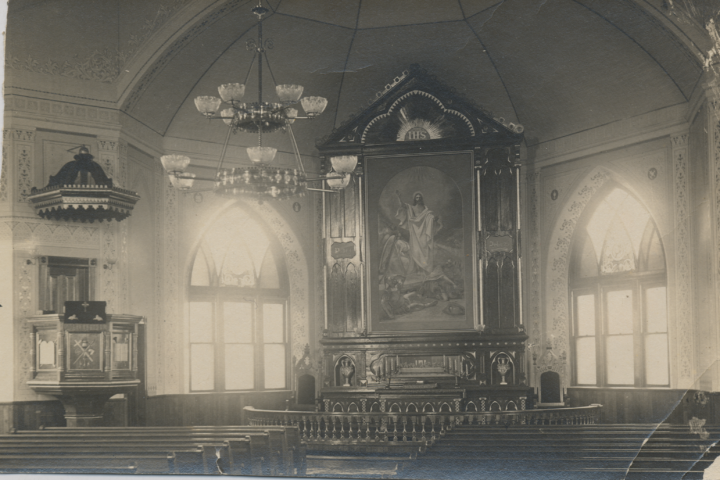
For many years, people have come to St. Peter each September to enjoy the Rock Bend Folk Festival’s music and sense of community. What many festivalgoers may not realize is that the name “Rock Bend” is rooted in the city’s earliest history.
To understand its meaning, we need to go back more than 160 years, to the period when this part of Minnesota was first opening to Euro-American settlement.
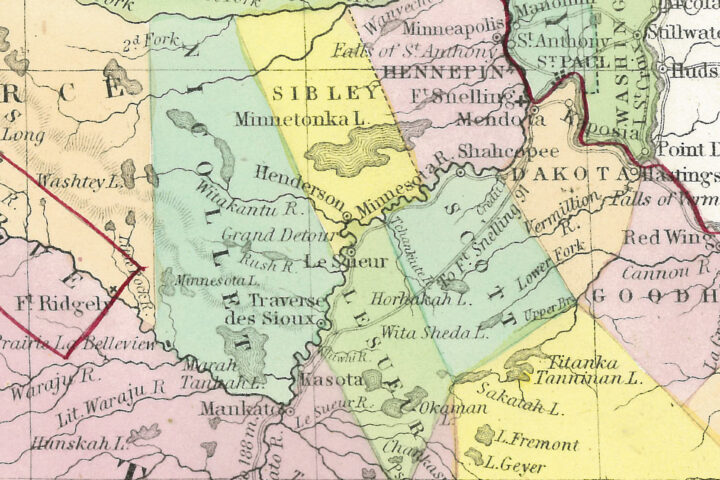
Before the provisions of the Treaty of Traverse des Sioux and the Treaty of Mendota took effect in 1853, it was illegal for settlers to claim land in much of southern Minnesota. That included the land along the Minnesota River where St. Peter and the Rock Bend Festival site would later develop.
In the autumn of 1853, William B. Dodd, often referred to as Captain Dodd, claimed land in what is now part of the City of St. Peter. Other claims in the same area were made by brothers Oliver Ames and William L. Ames.
Dodd was an ambitious promoter. He persuaded Minnesota Territorial Governor Willis A. Gorman to consider establishing a town along the Minnesota River on his claim. During the winter of 1853–1854, Gorman and several prominent figures from St. Paul, including Territorial Secretary J. Travis Posser, enlisted a young lawyer, Charles E. Flandrau, to travel up the river and evaluate the area’s potential.
Flandrau later recorded his impressions of the journey, which included explorations of the Minnesota, Blue Earth, and Le Sueur Rivers. He noted that settlements such as Shakopee and Mankato consisted of only a handful of residents, while the broader region was sparsely populated, aside from Dakota communities, fur traders, missionaries, and places like Traverse des Sioux. Flandrau was deeply impressed by the landscape, reporting that the land was well-suited to agriculture and that Dodd’s claim offered an excellent site for a future city.
At the time, Dodd’s claim, located north of today’s Broadway, together with the Ames brothers’ claims, formed a small settlement known as Rock Bend. According to Flandrau, the name came “from a turn in the river in front of the prairie, with a rocky wall which presented a fine landing for steamboats.” Rock Bend encompassed roughly 500 acres on both sides of the Minnesota River, primarily on the west bank.
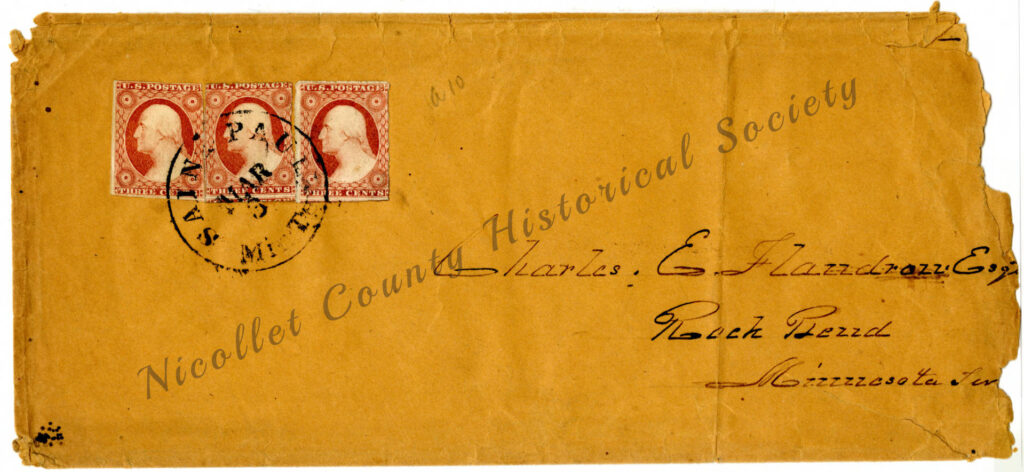
In February 1854, Gorman, Posser, and five other investors purchased seven-tenths of the claims held by Dodd and the Ames brothers. These nine men formed the St. Peter Company to develop a new town at the Rock Bend site. By August 22, 1854, the company filed its certificate of incorporation with the Nicollet County Register of Deeds, stating that it was organized “for carrying on generally a manufacturing, lumbering, agricultural and mechanical business.” The company issued 500 shares of stock at a par value of $10 per share.
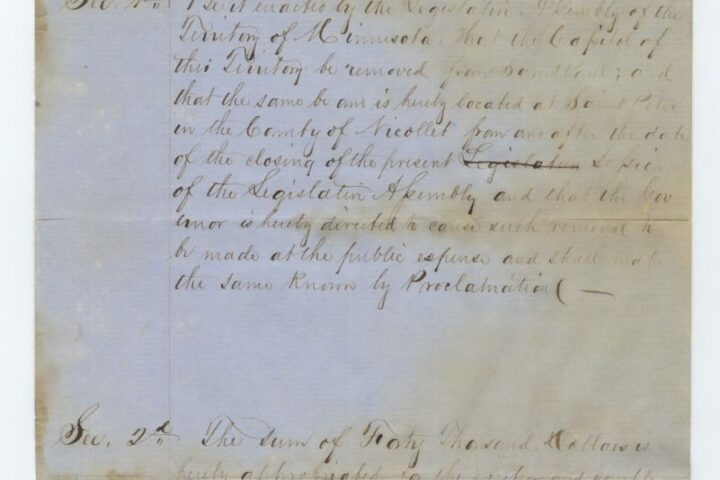
The land was surveyed and laid out into blocks, lots, and streets, and settlers were encouraged to relocate to the new community. In 1857, the St. Peter Company even attempted to move the Minnesota territorial capital to St. Peter. Although the bill passed the legislature, it famously disappeared when legislator Joe Rolette, who opposed the move, removed it from the Capitol building. By the time Rolette returned the bill at the end of the session, it was too late for Governor Gorman to sign it into law.
The name “Rock Bend” itself was short-lived. It appeared sometime after Dodd’s claim in 1853 and disappeared by 1854, when the St. Peter Company formally renamed the community St. Peter. The new name was drawn from an earlier name for the Minnesota River, the St. Pierre (French) or St. Peter River.
The people behind Rock Bend and early St. Peter were, in many cases, as compelling as the place itself. Dodd built the Dodd Road, an early route connecting St. Peter and St. Paul. He was killed during the fighting at New Ulm in the U.S.–Dakota War of 1862 while serving under Flandrau, who was in charge of the city’s defense. Flandrau went on to a distinguished legal career, serving as an agent to the Dakota people, a member of the Minnesota Constitutional Convention, and a justice of the Minnesota Supreme Court. Gorman, a veteran of the Mexican War, later served as a brigadier general during the Civil War.
Today, the Rock Bend Folk Festival carries forward a name that predates the city of St. Peter itself, linking a modern gathering of music and community to the earliest chapter of settlement along this bend of the Minnesota River.