
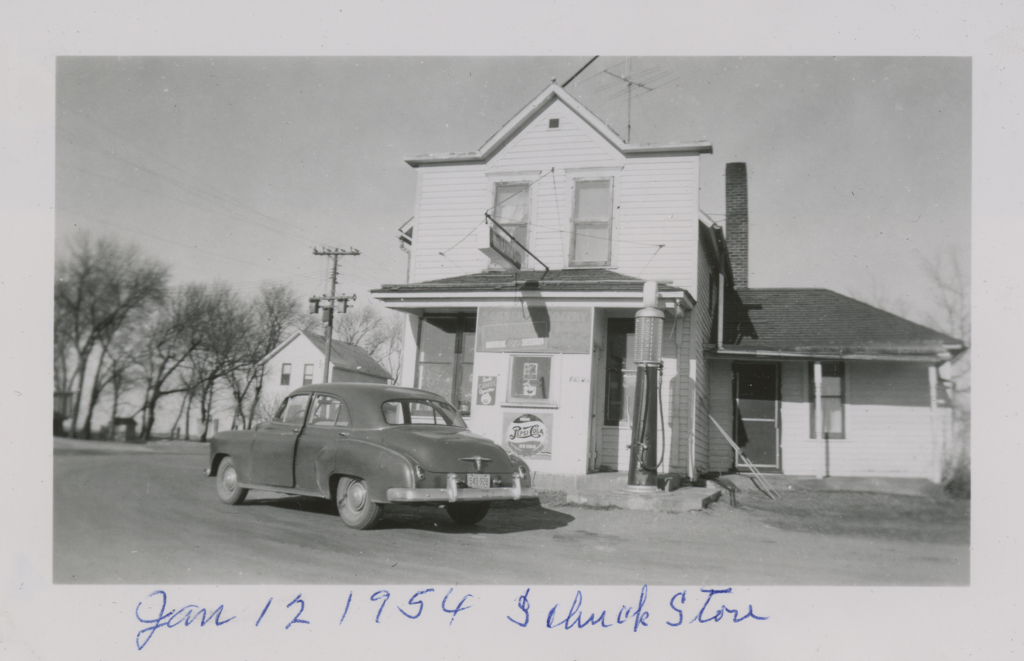
Little did I know when I was handed a pile of seemingly inconsequential papers piled haphazardly above a goldenrod kraft paper clasp envelope that I would find the story of a man with a knack for arithmetic, Jacob A. Schuck; a mother with six children and a store to her name, Josephine M. Schuck; a singing shopkeeper with a mother to care for, Arthur “Art” Schuck; and a son entrusted with putting his mother’s affairs in order, Frank Schuck.
As I went through the first account book within this collection, I imagined myself in the grocery aisles of 1973, surrounded by promises of “New and Improved!”—a familiar refrain in postwar food advertising. I imagined this singing shopkeeper, who had spent more than twenty-five years providing his mother with care and companionship adjusting his glasses before wandering into a brightly-lit grocery store. In my mind, there were shelves of colorful packages and a frozen-food case offering dinner without much fuss, features already established in American supermarkets by this time.
As he pushed his metal shopping cart toward the frozen dinners, I imagined him making the hard decision between Swanson’s turkey dinner and its fried chicken dinner—both options, in my further research of the time, that had existed long before this particular shopping trip. The account books do not settle that very important dinner debate for me. It gives me only “Frozen dinner,” June 28, 1973, and a charge of sixty-five cents. Yet I imagined him making his choice, unaware that the record of such a humble purchase would one day welcome a curious college student into what she would regard as the rich history behind his mundane task of buying groceries.
Oh, how many things we truly forget the significance of until one day they appear upon a young intern’s desk to explore. I would argue that the smallest paper I went through, a worn little card measuring just 2½ inches long by 3¼ inches wide, had as much to tell me as one of the largest. That piece of paper was Arthur John Schuck’s Selective Service Notice of Classification, dated May 7, 1943. It introduced me to a younger Art, whose name had found its way into the paperwork of a world at war.
Beside it, a warranty deed measuring 14 inches long by 8 1⁄2 inches wide recorded his parents, Jacob and Josephine Schuck, purchasing approximately one acre together in 1944. Read alongside the leases describing a general store and dwelling, these documents began filling in the person behind my sixty-five-cent frozen dinner: a son whose family’s home and business were closely connected.
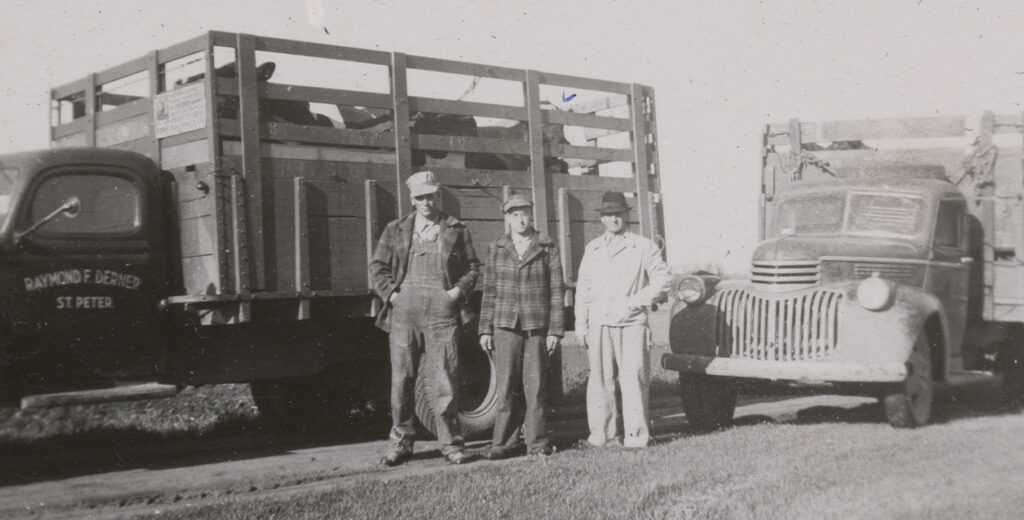
As if I had opened a copy of When Knighthood Was in Flower, the papers I had gone through made me curious about the relationship between Jacob and Josephine—although my edition seemed to contain considerably more property paperwork. With no account of their first meeting before me, I imagined them being introduced at a church basket social, surrounded by neighbors bidding on baskets of lunch, perhaps finding a reason to linger in conversation. A Minnesota church history recalls just such a gathering shortly after 1900, giving my imagination somewhere plausible to wander. Whether Jacob and Josephine ever attended one together, these papers do not tell me.
What they did let me follow was the life that came afterward. In 1908, Jacob signed a lease for land where a general store and dwelling were permitted, with the term beginning the following June. Then came a small green certificate recording Arthur’s birth on October 22, 1920, with Jacob and Josephine named as his parents. By 1944, their names appeared together on the deed as husband and wife and joint owners. I imagined the years between those papers filled with the ordinary interruptions of a household and a business sharing the same place: someone needing attention just as something else needed doing.
Then, in 1946, the wording changed. An affidavit recorded Jacob’s death on June 21 and identified Josephine as his surviving widow. I had been following their names together, and suddenly I was reading about what remained in her hands.
The story continued through Josephine and their son. On December 28, 1965, she sold Schuck Store to Art in exchange for a $6,000 note. Their November 2, 1971, agreement later acknowledged that note as paid, recognizing the care he had provided her over many years. Here was another relationship I had the privilege of decoding through paperwork: a mother and son whose business arrangements carried a record of their life together.
But the wondrous stories did not end! The papers surrounding that sale had introduced another Schuck for me to follow. On the very same day Josephine dated the store-purchase note, she also dated her will. Within its two pages, she made provisions for all six of her children, including securities and financial obligations purchased with her money, but held jointly with Art. Then came the name of the son she had chosen to put these wishes into motion: Frank Schuck. I had become so acquainted with Art through his groceries and his mother’s care that I found myself pausing over his brother’s name, wondering what place he would take in the papers still waiting beneath my hands.
Before I reached that answer, a handful of little brown slips brought me back to Josephine and Art. Measuring only five inches by three and a quarter inches, they recorded payments of $1,200, year after year, against the note. I followed the remaining balance from $4,800 in 1966 down to $1,200 in 1969. Then, on a slip dated June 9, 1971, came the words “Paid in full.” The November agreement gave that settlement its fuller explanation, recognizing Art’s years of care and companionship.
The papers did not explain every detail of how the recorded payments and that acknowledgment fitted together, but they gave me something to linger over: the language of a financial arrangement carrying the history of a mother and son. Then the dates brought me to July 1973. Josephine died on July 12, and once again the wording of the collection changed. I followed her name from the estate inventory into the certified records and through the court paperwork that carried her affairs forward.
The safe-deposit-box paperwork, dated the very next day, offered a closer look at the financial life behind those forms. As I read through its savings certificates and stock holdings, I came upon property documents and familiar references to the store’s earlier transfers. Art’s name appeared on some of those papers alone, while on others it still stood beside his mother’s. Among the signatures was Frank’s, signing for the estate. Here was the son I had met in Josephine’s will, now appearing in the work that followed her death.
On August 9, the court formally appointed Frank executor. The choice Josephine had put into writing almost eight years earlier had become an official responsibility. Art appeared in this chapter too. Two receipts dated October 25 recorded his payment of two dollars for a certified copy of his mother’s death record and one dollar for a certified copy of estate letters.
In November, Frank signed the petition and sworn statement requesting an inheritance-tax filing waiver. Following their names through these documents, I began to see the different tasks each son undertook. I wondered about the conversations surrounding those errands and signatures, the moments before and after someone approached a clerk’s desk. The receipts preserved the amounts paid; what those moments felt like remained something I could only wonder about.
And yet, further into the pile, ordinary life appeared again. An account book bearing Art’s name and the year 1978 returned me to pop, bananas, sandwiches, ice cream, and candy. After spending so long among the legal papers that had drawn me into his family’s affairs, I was back in the grocery aisle where my curiosity about Art had begun. There was something wonderful about encountering him there again. Another day had called for groceries, and another small purchase had found its way onto a page.
The latest securely dated document in the collection brought me to 1985, although the event it recorded took me all the way back to 1920. It was a certified copy of Art’s birth record, issued on May 14, with Jacob and Josephine named as his parents. I could not tell from the certificate why the copy had been requested. What caught my attention was where it had brought me: after meeting Art as a shopkeeper, a caregiver, a purchaser of frozen dinners, and a son attending to estate paperwork, I was looking at him once more as Jacob and Josephine’s child.
There was still one more story I wanted to share: A newspaper described Art writing a song about Hardee’s and being invited to perform at a managers’ retreat in Scottsdale, Arizona. Local restaurant employees helped with the arrangements, and the article followed his trip, the managers’ favorable response, and his return to Minnesota. I imagined him waiting for his turn to sing, carrying a tune that had taken him much farther from home than an ordinary trip for something to eat.
Here was my singing shopkeeper, stepping into a story that an account book could never have told me by itself. When I looked back at the pile that was now neatly organized and catalogued and stored in acid free folders, I thought about how easily I might have passed over any one of its pieces. A grocery charge had led me to Art. A lease and a deed had led me to his parents. A will had introduced me to Frank, whose name I could then follow through the estate papers. Together, they had given this modest intern the privilege of spending an afternoon piecing together parts of their lives. And to think, I had first stopped to wonder what kind of frozen dinner Art had chosen.
Autumn Pipes
NCHS Intern
Autumn is a senior at Minnesota State University, Mankato completing a double major in history and psychology with a minor in criminal justice.